Parking Management Platform

Parking Management Platform

Typical Application Scenarios

Overseas multilingual parking lots, commercial complexes, office buildings, residential communities, hotels and hospitals that require unattended vehicle access management.

Key Highlights

  1. System positioning: an on-premises, privately deployed smart parking management system for a single lot or a group of lots. It combines a local server with intelligent terminals and is accessed through a browser, with no client installation required.

  2. Local closed loop: license plate recognition, billing and settlement, gate decisions and data storage all run locally, so the parking lot continues to operate normally even if the external network goes down.

  3. Unattended operation: license plate recognition, voice broadcast, on-screen guidance, automatic billing and automatic gate opening, supported by remote cloud-duty handling.

  4. Globalization: the management interface supports more than 30 languages, with multilingual voice broadcast and on-screen text; currency units and location are configurable.

  5. Unified multi-device access: cameras, RFID readers, LED displays, barrier controllers and ticket printers are managed centrally through dual MQTT and HTTP channels.

  6. Single-package delivery: front-end resources are built into the back-end service, so a single deployment enables browser access and reduces delivery and maintenance costs.

Core Value

An on-premises smart parking management platform for single sites and multi-site parking groups.

It runs on a local server with intelligent terminals and is accessed through any browser—no client installation required.

ANPR cameras, RFID readers, LED displays, barrier controllers and ticket printers are unified on one platform to enable unattended entry and exit, automatic billing and gate control.

Because recognition, billing, gate decisions and data storage all run locally, the parking lot keeps operating even when the external network is down.

The management interface supports 30+ languages, with multilingual voice broadcast and display text for overseas deployments.

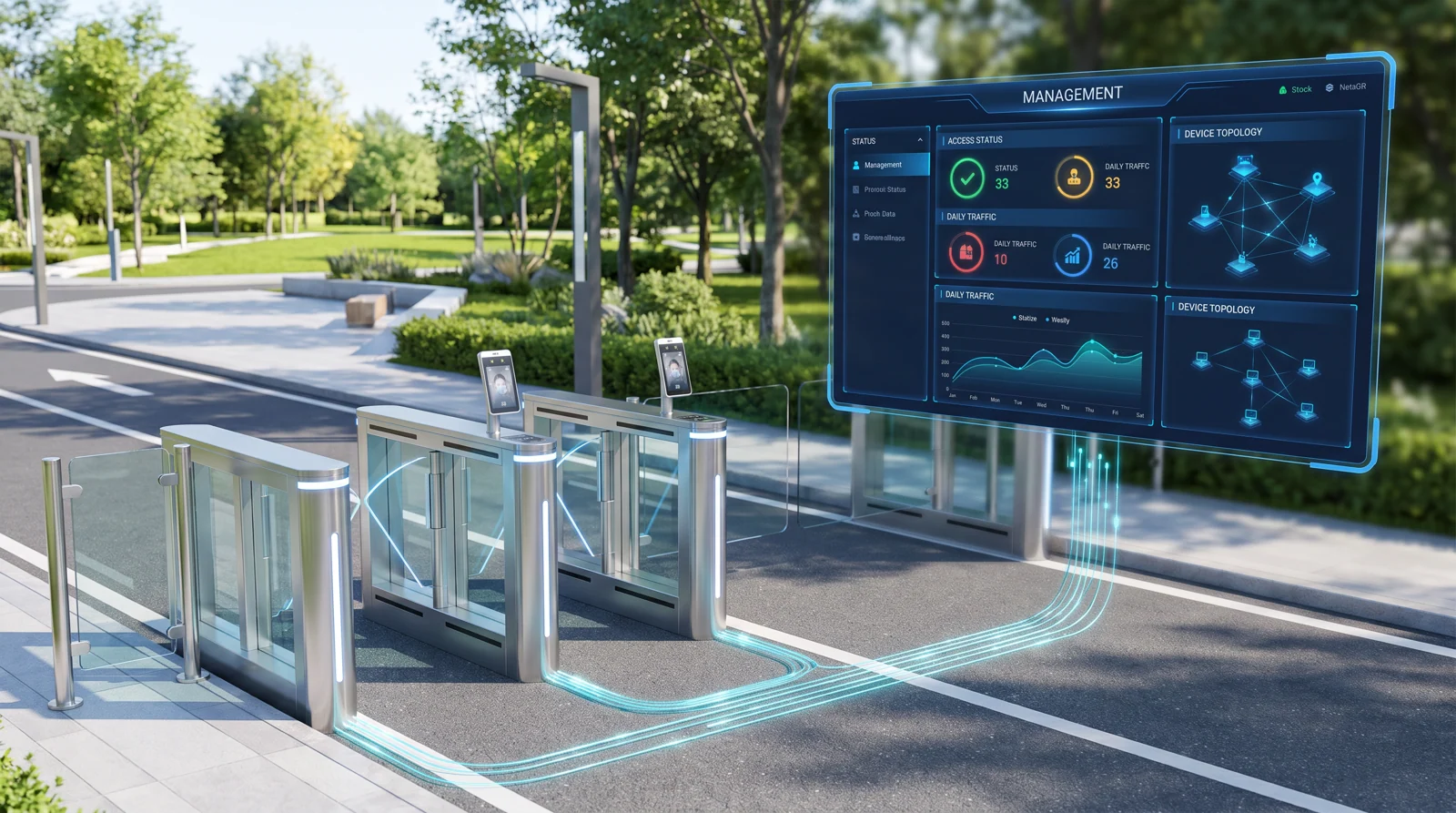
Connected parking access illustration from the supplied design

Core Modules and Features

Dashboard and analytics — Parking Platform V4 interfaceOpen interface preview

Dashboard & Analytics

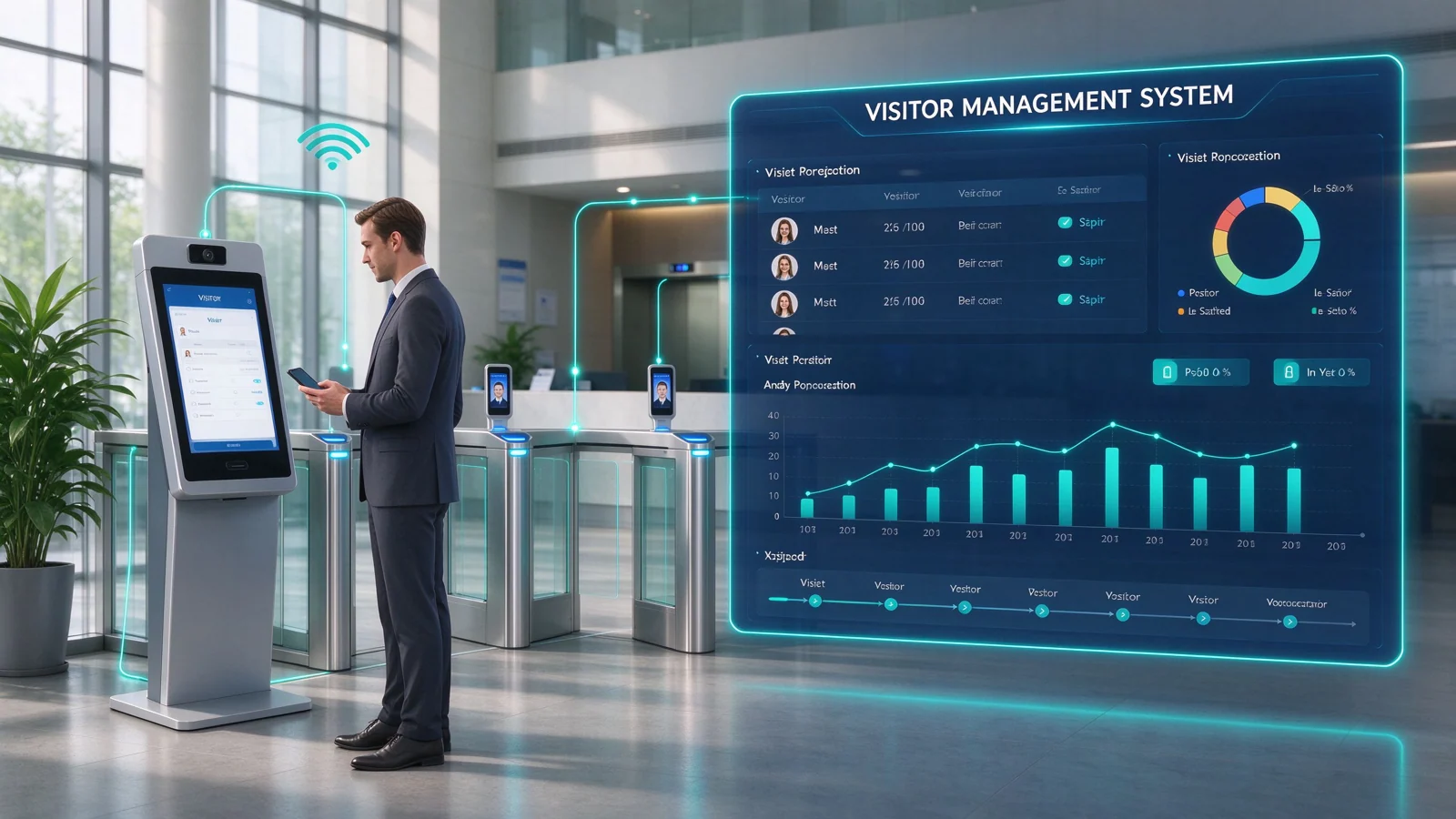
Home dashboard covering today’s and total revenue, fixed-vehicle and temporary-vehicle revenue, vehicles on site and remaining spaces, revenue trends, traffic comparison, vehicle composition and device online status.

Parking zones — Parking Platform V4 interfaceOpen interface preview

Parking Resource & Device Management

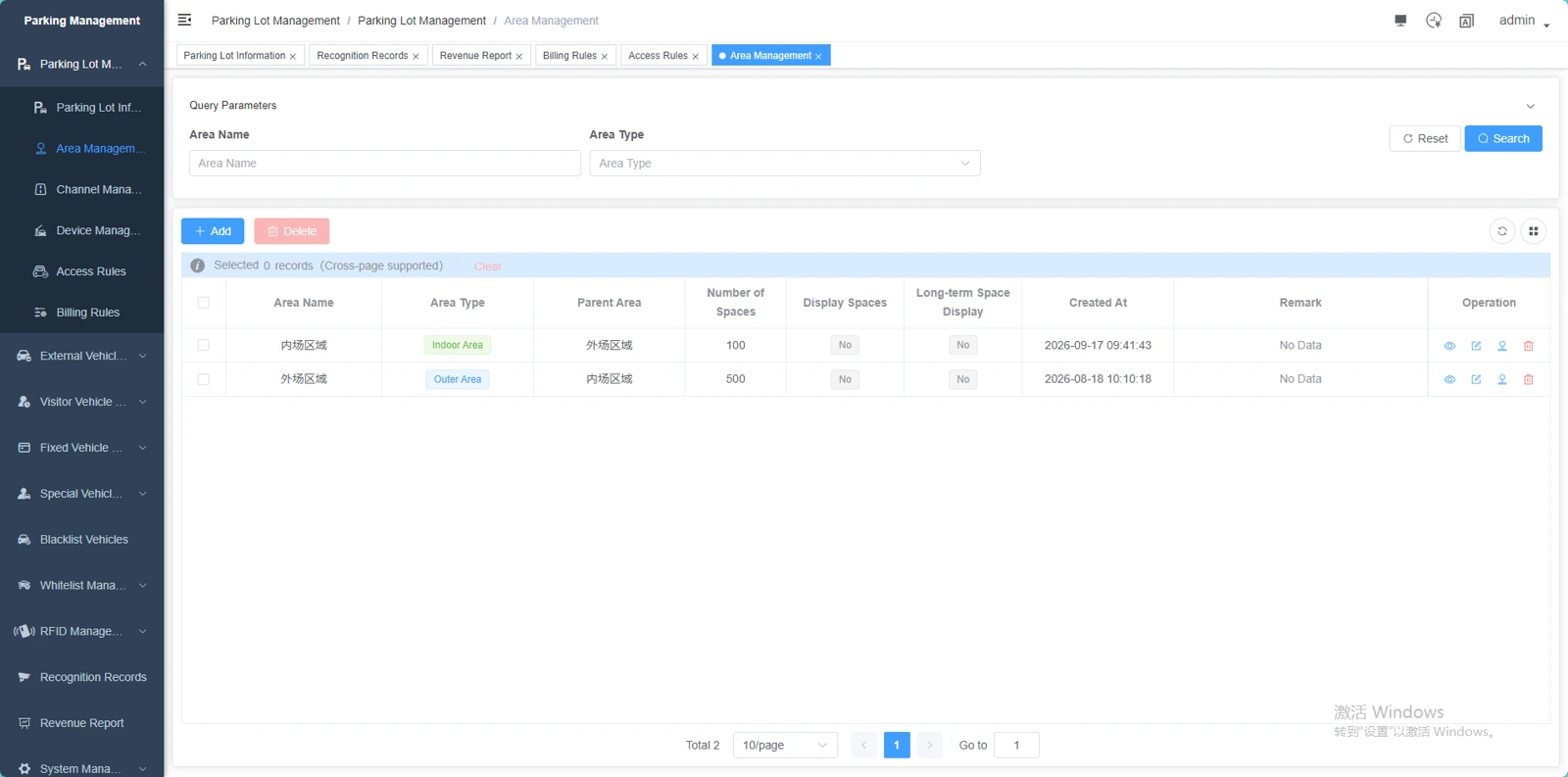
Centralized maintenance of parking lot information, zones, lanes and device inventory, with configurable space counts and lot-full policies.

Billing configuration — Parking Platform V4 interfaceOpen interface preview

Smart Billing Engine

Three billing modes (hourly, duration and visit count) with free time, starting price, a 24-hour cap and periodic billing; a billing simulator is provided for validation.

Access and gate rules — Parking Platform V4 interfaceOpen interface preview

Access Control & Gate Rule Engine

Access control plus a gate-rule engine that evaluates blacklist, lot-full, validity, payment status and time-based restrictions in order.

Vehicle service types — Parking Platform V4 interfaceOpen interface preview

Multi-Type Vehicle Services

Fixed vehicles, whitelists, blacklists, special vehicles, RFID, face-registered personnel and visitor services; supports single entry and Excel batch import.

Order & Payment Management

A complete financial trail of parking orders, payment records, fixed-vehicle payments and coupon redemption.

Records & Traceability

Full retention of recognition, passage and gate-opening records, including entry and exit images, with configurable retention days.

Role management — Parking Platform V4 interfaceOpen interface preview

Role & Permission Management

A user–role–menu model with fine-grained, menu-level permission control.

System Monitoring & Configuration

Menu management, parameter configuration, system logs, scheduled tasks and scheduling logs.

Globalization (i18n)

An interface in 30+ languages, multilingual voice and on-screen text, and configurable currency and location.

System Integration and Architecture

Layered architecture, from bottom to top:

terminal device layer, communication access layer, application service layer, support service layer and data storage layer.

Communication:

dual MQTT and HTTP channels. Device-specific commands are abstracted into a unified IoT command model and routed by the command engine according to device type.

Technology stack:

Spring Boot 2.7, MySQL 8.0, Redis, Sa-Token/JWT, Eclipse Paho MQTT and Vue 3, with the built front-end resources included; the default service port is 58888.

System Integration & Architecture

Local software · Connected devices · Coordinated vehicle access

Parking management software

Unified scheduling and business rules

MQTTHTTP
ANPR cameras
Barrier gates
RFID readers
LED displays
Ticket printers
  1. Data storage layer
  2. Support service layer
  3. Application service layer
  4. Communication access layer
  5. Terminal device layer

MySQL 8.0 · Redis · Local data storage

Entry workflow

  1. 01ANPR recognition
  2. 02Check access rules
  3. 03LED & voice guidance
  4. 04Gate-open command
  5. 05Barrier rises
  6. 06Create entry record

Exit workflow

  1. 01ANPR recognition
  2. 02Match record & order
  3. 03Calculate parking fee
  4. 04Payment
  5. 05Evaluate gate rules
  6. 06Barrier rises

Unsuccessful gate-rule evaluation → spoken reason and cloud-duty handling.

Entry Flow: A vehicle approaches, and the ANPR camera captures and recognizes its plate. The system checks blacklist, lot-full, validity and authorization, then provides LED and voice guidance. The local software sends the gate-open command and the barrier rises. A recognition record and an on-site record are created, while ground loops and anti-smash mechanisms protect the vehicle.

Exit Flow: After plate recognition, the system matches the on-site record and order, determines the vehicle type and calculates the fee according to the billing rules. Payment is made at the payment kiosk, by QR code or in cash. The gate rules are then evaluated and the barrier rises. If evaluation fails, the vehicle is blocked with a spoken reason and routed to the cloud-duty console for manual handling.

Security, Compliance & Deployment

Deployment Options

  • On-Premises (implemented): a local server with intelligent terminals, browser access and single-package delivery with a built-in front end; no separate web server is required.
  • Supports single lots and lot groups without depending on the external network, with recognition, billing, gate control and storage running as a local closed loop.

Data Security (Implemented)

  • Sa-Token login authentication issues a token with a default validity of 24 hours, using header-based authorization and supporting concurrent multi-device login.
  • Password policy: new passwords must be at least 12 characters and contain both upper- and lower-case letters and special characters.
  • Druid’s wall firewall filter is enabled to prevent SQL injection.
  • Open device APIs are grouped separately from management APIs, and key operations are recorded in the system log.

Compliance and Items to Confirm

  • AES-256 encryption and HTTPS/SSL transport encryption are not mentioned in the manual and must be confirmed against the actual technology.
  • PCI-DSS and target-market privacy regulations, such as GDPR, must be confirmed based on the export region and payment methods.
  • Encryption and certification standards not stated in the manual must not be advertised as established facts.

Video

Commercial Parking video cover
Watch on YouTube ↗

Case Studies

Kigali Business Center

Kigali Business Center

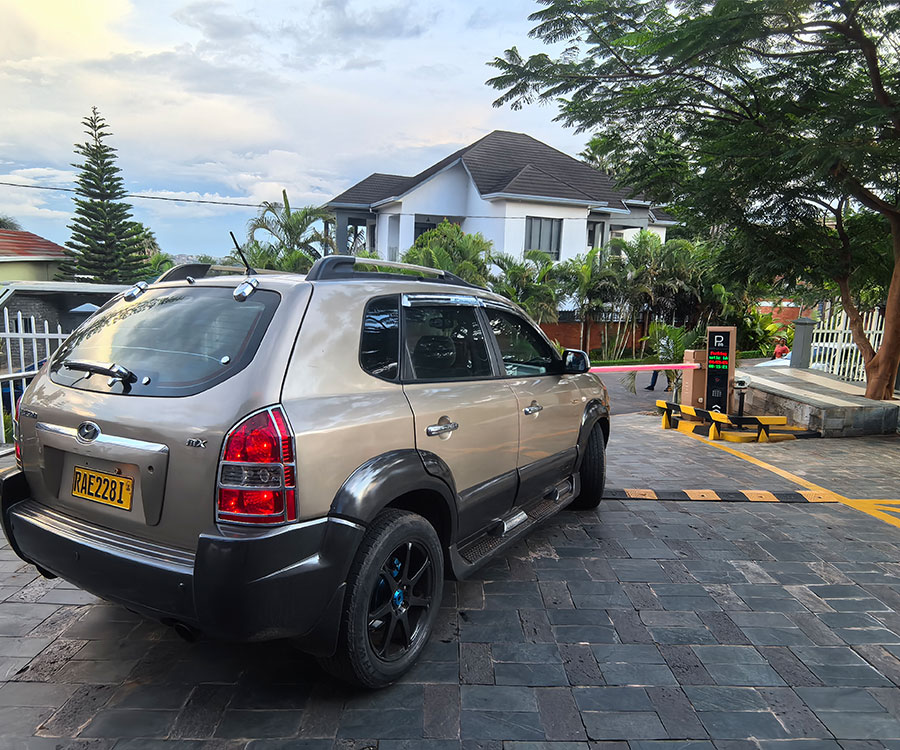
Kigali Alliance Business Center represents the pinnacle of commercial real estate development in Rwanda. KABC was conceived to address the growing demand for world-class business facilities in Kigali's rapidly expanding economy. Located strategically in the heart of Kigali's business district, mixed-use development combines premium office spaces, retail opportunities, dining experiences, and wellness facilities under one roof. and more than 200 parking spaces. With a 95% occupancy rate and increasing vehicle traffic, the parking lot needed to manage not only internal customer vehicles but also temporary parking access. After several months of discussions, the Qigong parking management system and payment system were ultimately chosen to provide effective assurance for parking lot security and revenue.

View more ↗
Tribhuvan International Airport

Tribhuvan International Airport

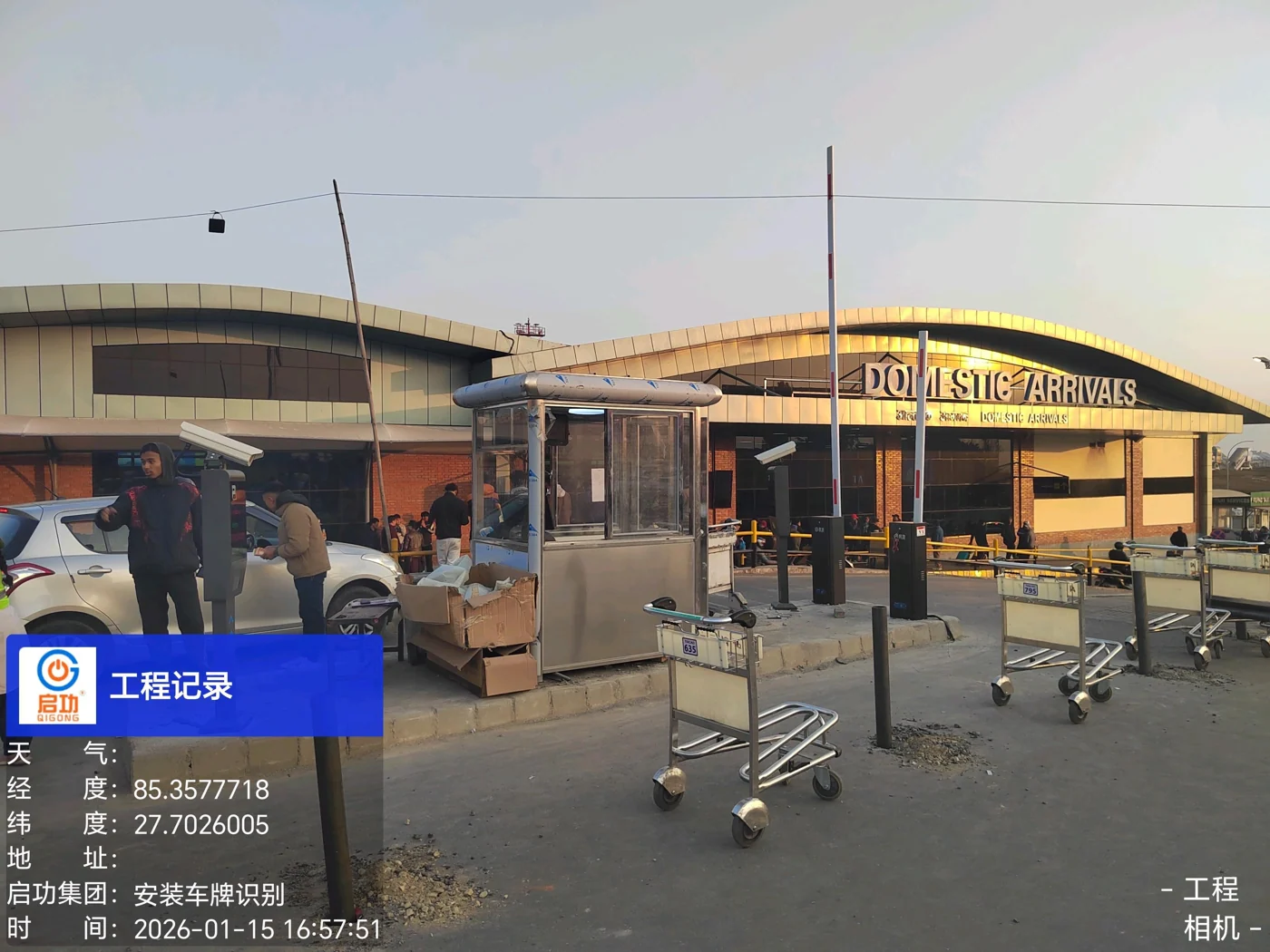
Tribhuvan International Airport, located in Baghmati, Kathmandu, Nepal, is the country's main international airport, connecting Nepal to over 40 destinations in 17 countries. In recent years, passenger traffic at Tribhuvan International Airport has grown rapidly, far exceeding the airport's designed annual throughput capacity of approximately 8 million passengers. In the first 11 months of 2025, the cumulative passenger volume reached approximately 7.8 million, including approximately 4.1 million international passengers and 3.7 million domestic passengers. This surge in parking demand prompted the parking lot operator to engage Qigong Parking for a redesign and intelligent parking system, addressing the safety and image issues caused by traffic congestion and parking difficulties.

View more ↗
Simba Center Kigali Shopping Center Parking Management Solution

Simba Center Kigali Shopping Center Parking Management Solution

Simba Center is a comprehensive shopping mall in Kigali, Rwanda, featuring a large supermarket, retail stores, a children's entertainment area, restaurants, and a rooftop bar. In 2022, the center introduced the QIOGNG advanced automated parking management system, which includes parking ticket machine, license plate recognition control system, and parking self-service payment machine system. The parking lot has approximately 200 parking spaces, all located at ground level. It serves a diverse customer base with high traffic volume, including amusement parks, supermarkets, restaurants, and cafes. The demand for parking efficiency is increasing, necessitating a comprehensive upgrade to modern electronic payment parking management.

View more ↗

Download Center

Document nameAction
Product manual—
Installation guide—
CAD model—
Product specifications—
Certificate—

Related System

Technical support and maintenance

Existing O&M capabilities: regular backup of the database and the image directory (/uploads/images/), system-log troubleshooting, and configurable recognition-record retention (-1 means permanent).

Offline devices can be investigated through device status and video; camera configuration files can be backed up and restored; background tasks are monitored through scheduled tasks and scheduling logs.

PROJECT WORKFLOW

Plan the complete parking operation

From recognition to release

  • On entry, identify the vehicle and evaluate its access permissions before opening the barrier.
  • On exit, match the on-site record, calculate the fee, complete the chosen payment route and evaluate gate-release rules.
  • Review unrecognized plates, missing entry records and failed payments with the operator exception process.

Prepare the rollout

  • Provide the site and lane plan, expected traffic, user groups and plate examples.
  • Agree tariffs, free time, discounts, fixed-user validity, lot-full behaviour and exception handling.
  • Confirm device interfaces and test the local operating process, payment callbacks and operator roles before handover.

START YOUR SMART ACCESS PROJECT

Let’s build a better way in.

Tell us about your site. Our team will help you plan the right solution.

Request a quote

Let's talk about your current problem

Tell me about your needs and I will respond to you in the shortest possible time